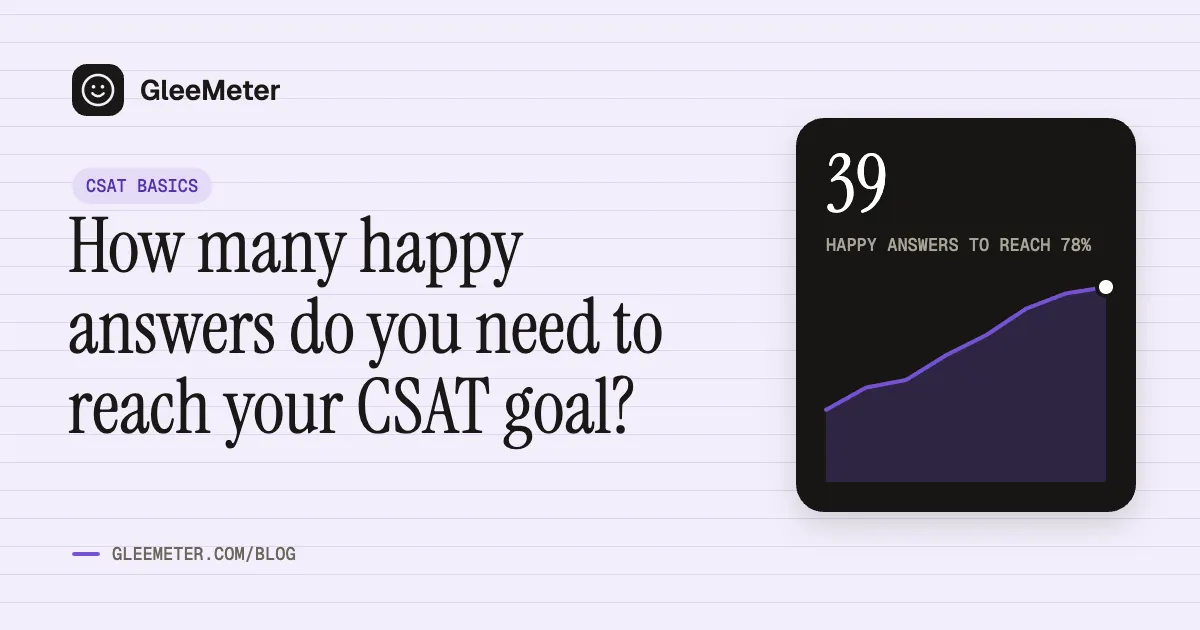
How many happy answers do you need to reach your CSAT goal?
To reach a CSAT goal, your new answers must score above it. Divide the gap in happy answers by how far new answers beat the goal.
To reach a CSAT goal, your new answers must score higher than the goal itself. The more answers you already have, the more new ones it takes. Here is the math, with two worked examples you can copy.
The three numbers you need
- Happy answers so far, such as 4 and 5 ratings on a 1 to 5 scale
- All answers so far, happy or not
- Your goal, written as a decimal, so 78% becomes 0.78
Count happy answers the same way every time. U.S. federal agencies use this rule for their trust surveys. Performance.gov adds up the 4 and 5 answers, then divides by all answers.
Step 1: find the gap
Take a hotel front desk with 132 happy answers out of 180. Its score is 73.3%, and the manager wants 78%.
Goal in happy answers: 0.78 × 180 = 140.4
Gap: 140.4 − 132 = 8.4
The desk is 8.4 happy answers short at today's size. Each new answer also grows the total, so the real count is higher.
Step 2: the best case
Say every new guest leaves a happy rating. Each one closes 1 − 0.78 = 0.22 of the gap.
8.4 ÷ 0.22 = 38.2, so the desk needs 39 happy answers in a row.
Check: 171 happy out of 219 gives 78.1%.
Question A in the GleeMeter calculator gives this best case count for your own numbers.
Step 3: the realistic case
Few desks get 39 happy guests in a row. Say new answers come in 88% happy instead.
Each new answer now closes 0.88 − 0.78 = 0.10 of the gap.
8.4 ÷ 0.10 = 84, so the desk needs 84 more answers.
About 74 of those 84 answers must be happy. Check: 206 happy out of 264 gives 78.0%.
Why a score can get stuck below the goal
If new answers come in at exactly 78% happy, each one closes nothing. The score then sits just under the goal for good.
New answers below 78% pull the score further away. Fix the cause first, starting with the comments behind unhappy ratings.
A big survey history moves slowly
Now take a software support team with 1,155 happy answers out of 1,750. Its score is 66%, and the goal is 69%.
Goal in happy answers: 0.69 × 1,750 = 1,207.5
Gap: 1,207.5 − 1,155 = 52.5
Best case: 52.5 ÷ 0.31 = 169.4, so the team needs 170 happy answers in a row.
Realistic case, with new answers 74% happy: 52.5 ÷ 0.05 = 1,050 more answers.
Check: 1,932 happy out of 2,800 gives 69%.
The team gets 175 answers a week. 1,050 ÷ 175 = 6, so the goal takes 6 weeks.
Score a recent window instead
Old answers hold a long running score in place. A score of only the last 90 days lets recent work show up faster.
Say the support team's last 90 days hold 410 happy answers out of 560. That window scores 73.2%, already above the 69% goal.
Pick one window and keep it. Switching windows between reports makes the trend look better than it is.
How to set a goal you can reach
- Start from your weekly answers. A goal that needs 1,050 answers takes 6 weeks at 175 a week, but 24 weeks at 45.
- Know your recent happy rate. It has to sit above the goal, or the goal stays out of reach.
- Give each goal a date. Use the weeks from your math, then add room for slow weeks.
- Read the trust range too. A small team can hit a goal on luck alone.
Before you call a new score a win, check whether your CSAT change is real. To plan the survey size behind it, see how many responses you need.
Frequently asked questions
How do I work out the happy answers needed for my CSAT goal?
Multiply all your answers by the goal, then subtract your happy answers. Divide that gap by 1 minus the goal. The result is how many happy answers you need in a row.
Why is my CSAT score stuck below the goal?
Your new answers are probably not scoring above the goal. If they only match it, the overall score cannot climb past it.
Should I restart my CSAT score to hit a goal faster?
No. Score a rolling window, such as the last 90 days, instead. Recent work shows up quickly, and every report stays comparable.
Keep reading
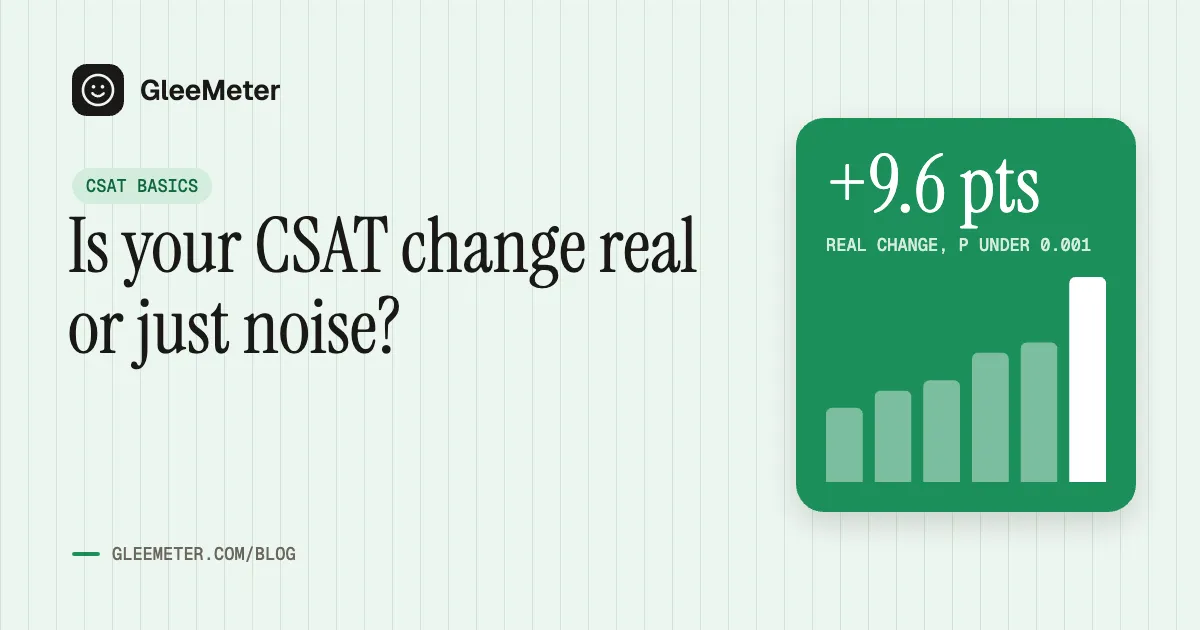
Is your CSAT change real or just noise?
A CSAT change counts as real when it is bigger than normal survey noise. Compare both periods with a two proportion test, and trust the change only when p is under 0.05.
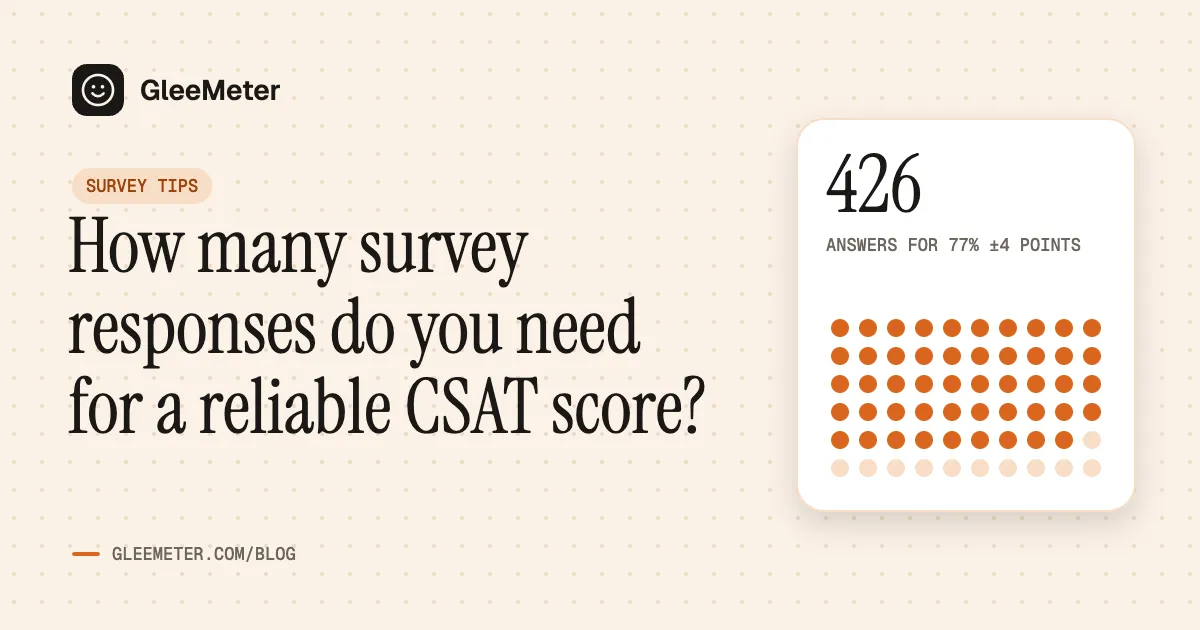
How many survey responses do you need for a reliable CSAT score?
For a CSAT score within 5 points, you need between 139 and 385 answers. The closer your score sits to 50%, the more answers you need.