How many survey responses do you need for a reliable CSAT score?
For a CSAT score within 5 points, you need between 139 and 385 answers. The closer your score sits to 50%, the more answers you need.
A score from 25 answers and one from 2,500 answers can look identical. Only the bigger one is steady enough to plan around. Here is how many answers you need, and what to do with fewer.
The short answer
The count depends on your score and on the error you can live with. These counts use 95% confidence.
- Score near 90%: 35 answers for ±10 points, 139 for ±5 and 385 for ±3
- Score near 70%: 81 answers for ±10 points, 323 for ±5 and 897 for ±3
- Score near 60%: 93 answers for ±10 points, 369 for ±5 and 1,025 for ±3
Scores closer to 50% need more answers, and scores near 90% need fewer. If you are unsure, use the count for the lower score.
For most teams, ±5 points shows real trends without months of waiting.
Why small samples swing so much
Each answer weighs more in a small survey. With 25 answers, one unhappy customer moves the score by 4 points. With 600 answers, that customer moves it by under a fifth of a point.
The trust range shows the effect. Here is a score near 64% at three sizes:
- 25 answers: the real score is likely between 44.5% and 79.8%
- 150 answers: likely between 56.1% and 71.2%
- 600 answers: likely between 60.1% and 67.7%
These ranges come from the Wilson method. It also powers the trust range in our calculator.
How to work out the number yourself
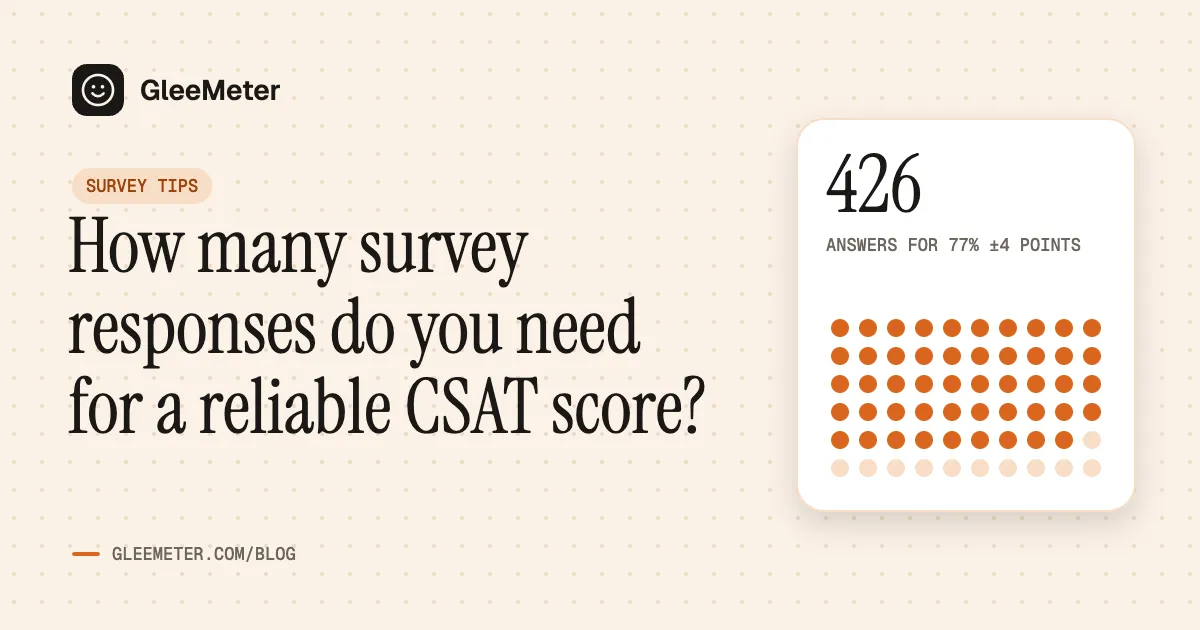
The formula needs your expected score, the error you accept and 1.96 for 95% confidence. Penn State teaches the same formula in its statistics course. Here it is for a 77% score and an error of 4 points:
- Square 1.96: 1.96 × 1.96 = 3.8416
- Multiply the score by what is left: 0.77 × 0.23 = 0.1771
- Multiply those two results: 3.8416 × 0.1771 = 0.6803
- Square the error: 0.04 × 0.04 = 0.0016
- Divide: 0.6803 ÷ 0.0016 = 425.19, then round up to 426 answers
You can skip the math. Question B in the GleeMeter calculator gives the count for your own score and margin.
How long it takes to reach your number
Divide the answers you need by the answers you get each week. Then round up to the next full week.
Say a clinic gets 55 answers a week and needs 426.
426 ÷ 55 = 7.75, so it needs 8 weeks of answers.
Now say an online store gets 210 answers a week and needs the same 426.
426 ÷ 210 = 2.03, so it needs 3 weeks of answers.
That sets the reporting rhythm. The clinic should report CSAT every two months. The store can report every three weeks.
What to do with fewer answers
- Combine periods. Join two or three months into one score instead of reporting each month alone.
- Report the range next to the score, such as "64%, likely between 56% and 71%".
- Compare people only when their ranges stop overlapping, so nobody gets ranked on luck.
- Read the comments, which often explain a low score faster than more ratings do.
How to collect more answers
- Open with one rating question and keep any comment box optional.
- Send the survey on the same day as the visit, order or chat.
- Ask inside the chat, app or email thread where the moment happened.
- Stop at one reminder, so customers do not learn to ignore you.
- Thank each customer in one short line after they answer, so they reply again next time.
Once you know your number, check whether your last change was real. Our guide to telling a real CSAT change from noise walks through two worked cases.
Frequently asked questions
How many responses do I need for CSAT?
For a score within 5 points, you need between 139 and 385 answers, depending on how high your score is.
Is 100 responses enough for CSAT?
It is enough for a rough read. At a 90% score, 100 answers give a range of about plus or minus 6 points. At 60%, the range grows to about plus or minus 10 points.
Do I need more responses for a 1 to 10 scale?
No. The count depends on the share of happy answers, so the scale itself does not change it.
Keep reading
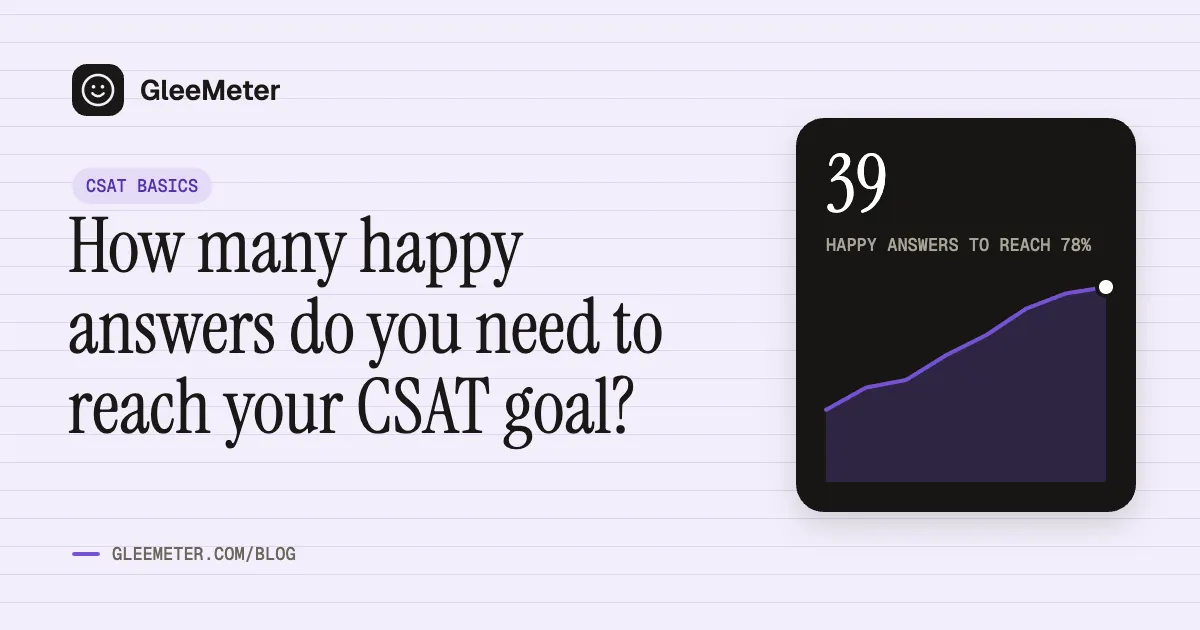
How many happy answers do you need to reach your CSAT goal?
To reach a CSAT goal, your new answers must score above it. Divide the gap in happy answers by how far new answers beat the goal.
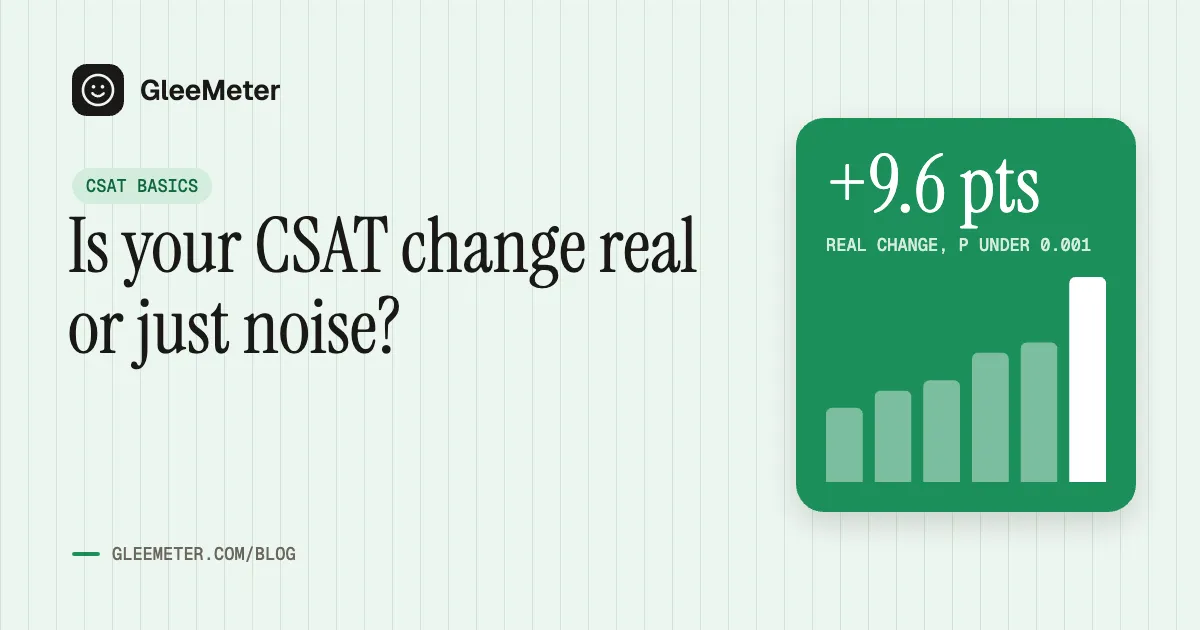
Is your CSAT change real or just noise?
A CSAT change counts as real when it is bigger than normal survey noise. Compare both periods with a two proportion test, and trust the change only when p is under 0.05.